

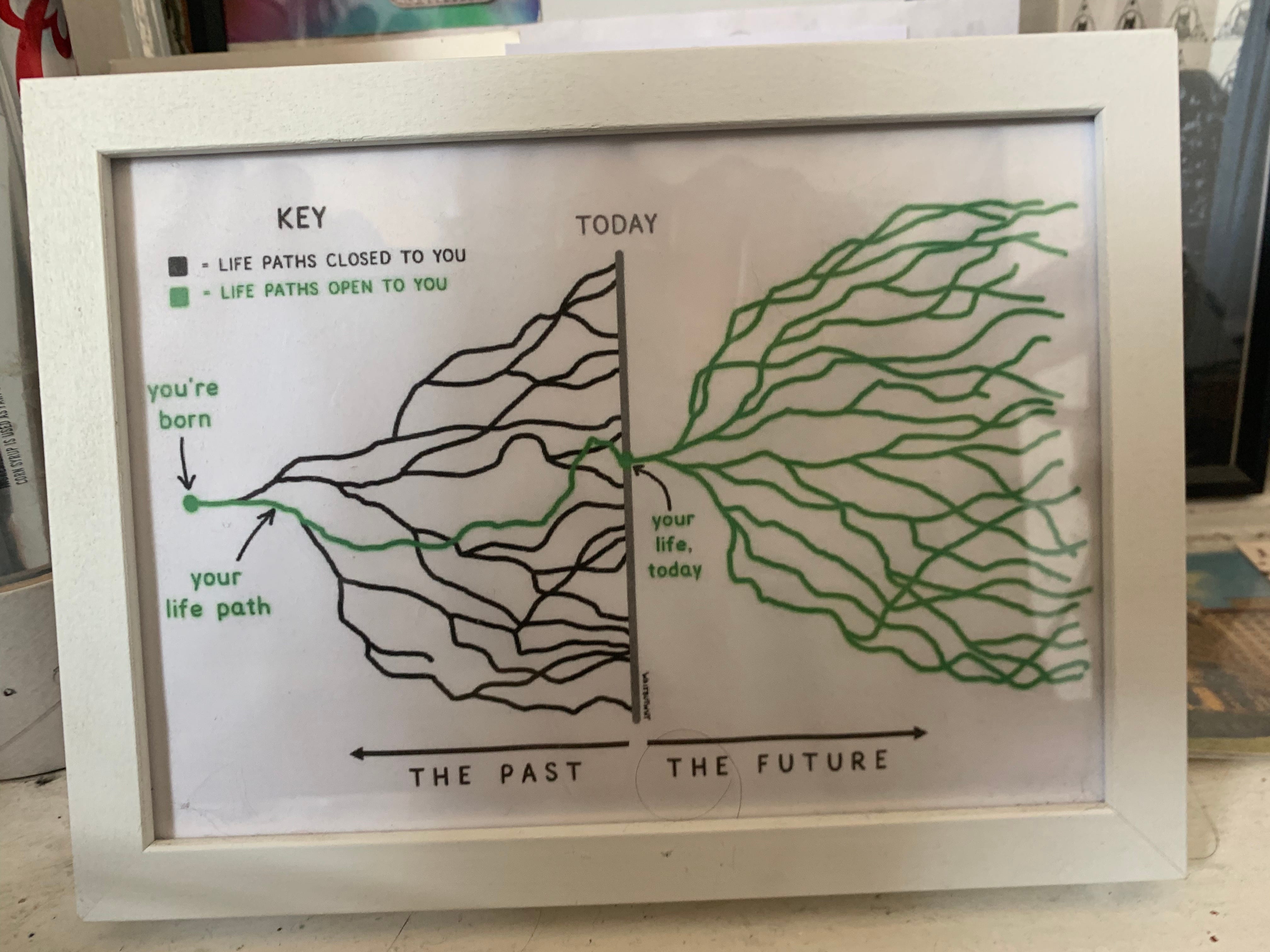
Lately, it feels as if everyone I know has either been laid off, is bracing to be laid off, or has pre-emptively jumped into freelancing so that they can tell our industry “no, I broke up with you.” When I hang out with old colleagues, it’s common for at least half the table to be looking for work. And among the employed half, many carry job titles that are a downgrade compared to what they did before.
It’s mostly scary and gloomy. Mostly, because somewhere in the clouds I can sometimes glimpse a lighter, exhilarating shade of positive opportunity.
Must a gloomy future be our hardened destiny?
I’m in the middle of reading Jenny Odell’s Saving Time, and thus far the main lesson from it is that modern society tends to think of time as linear and inflexible. We look back on history as if it had to turn out the way it did. And though the future hasn’t happened yet, we treat one (bad) version of it as unavoidable and choose to prepare for it instead of considering the possibility that things could happen another way.
Odell, however, reminds us that the universe is random, time isn’t fixed, and that we can always loosen the grip of any future that “must” happen.
And that’s good, because right now, the future we’ve all agreed to march toward totally blows! It’s totally catastrophic! Elle Griffin Griffin is right: we must loosen its grip on us.
Yet loosening this grip is very difficult, or at least has been until now. And it all boils down to an old friend, the scapegoat that’s so easy to blame while we throw our hands in the air.
What does “lack of political will” mean, and why might right now be the best opportunity to override it?
I’d wager that there’s more agreement than it seems around what needs to be done to avoid, say, maximal environmental collapse. But when it comes to action, people point at each other and cite “lack of political will.” Something along the lines of “X people will never let go of their SUVs,” or “try convincing Y people to give up the salaries that they worked so hard at school to achieve.”
The common thread, I think, is people (at least people who weren’t in legitimate material precarity) being unwilling to let go of their identities. Specifically, the relative sense of status over others that comes with them. If you’re at all into Howard Zinn or historians of his ilk, you learn to see American society as an exercise of power artfully giving crumbs of status to people it otherwise despises to keep them from burning the house down.
In the last few decades, this has consisted of stroking the ego of office schmucks and convincing them that their “skilled” work made them immune to the misfortunes afflicting blue collar stiffs. (How is pushing power points more “skilled” than welding or carpentry, by the way?)
But recently, the powers that be forgot to romance their bodyguards. What’s more, they seem to have turned their destructive power toward them (gleefully, might I add), stripping more and more white collar workers of their livelihood and stopping any talk of anyone but capital owners having dignity in their version of the future.
Which brings me back to my table of disoriented and stressed colleagues. All of this is anecdotal, of course, but I’ve noticed a marked change in the nature of our conversations. I no longer get the sense that anyone wants to (or feels like they can) climb in our industry. I no longer see anyone being guarded or coy about struggling.
And when it comes to big, societal lifestyle changes, I no longer hear anything about political will. Instead, I see a newfound appreciation for just how oblivious we have been to the industries that have been going through this for a generation now. And I sense more openness to new possibilities than ever.
As our old, status-driven identities collapse, we may be able to adopt ones better suited for the times. And we may be able to shape a different future. Even if the path to get here has been painful, it feels like a net positive, this acceptance of uncertainty and pathlessness.
Of course, that doesn’t mean we’ll take well to it.
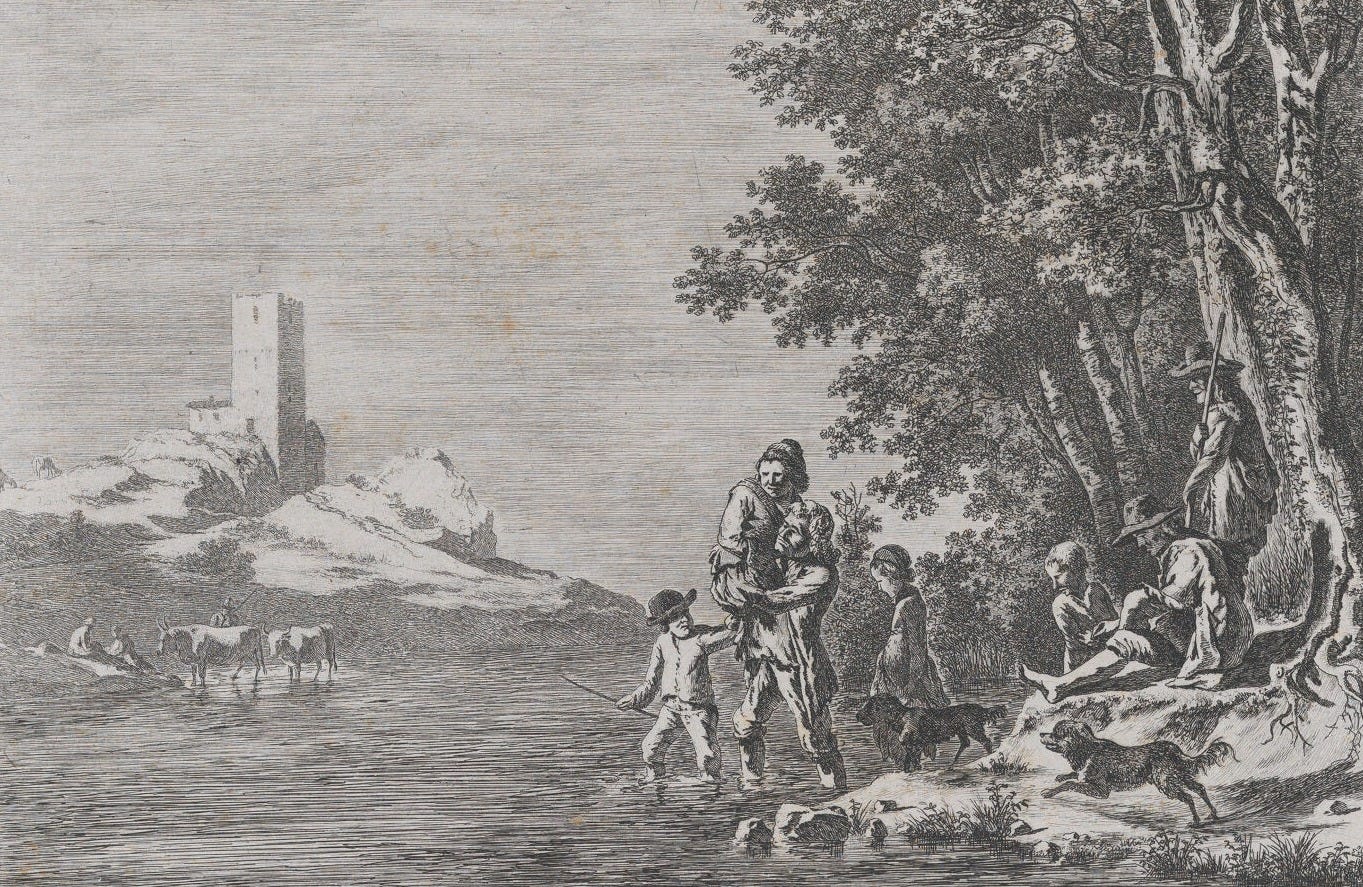
Can Americans handle feeling their way across the river?
Even if you believe in American exceptionalism, you have to admit our country is exceptionally ill-suited for this type of shift.
In this remarkable comparison of Chinese and American political philosophies, Ryan Chapman quotes former Chinese leader Deng Xiaoping as saying that he never had a “grand plan” and that his approach to governing was similar to “feeling his way across a river.”
Imagine someone in the US getting elected after saying that. Never happening! In this country, it’s completely unacceptable not to know the future in advance.
(Yes, I realize Deng had the luxury of not needing to explain himself to voters. But the underlying comfort with unglamorous trial-and-error is the point.)
But this is a post about loosening identities, after all, so I’m not going to write us off. Maybe the biggest question we face on our 250th birthday is whether our cultural condition has left any room for us to ride the wave of uncertain and loosening futures, or whether we’re going to plunge into catastrophe as soon as we stand on the board.
A mass identity collapse among white collar workers can only loosen our future if paired with organization, material safety, and new institutions. Otherwise, it just produces more scared people who may harden us into an even worse situation.
That prior generations got through the Great Depression through mutual aid and social arrangements that would feel alien to anyone today gives me great hope. That five years ago people wanted to riot over being asked to put a small piece of cloth over their face…not so much.
Starting with the scared nobody in the mirror
And lest you think I’m high and mighty on my soapbox, I count myself among the sorry rank of softies. Despite posturing to myself and others, I’m mostly terrified and clinging for certainty. At least twice a week I find myself yearning for a neat, legible story to tell others about how I make my money. I still find it hard to believe anyone will respect me without one.
All despite the fact that I’ve been freelancing for a year by choice. Or that I have more experience with sabbaticals and unemployment than most of my colleagues. Let alone that I’ve been writing an antiwork blog for five years and intellectually find the idea of “pathlessness” incredibly appealing.
But the deep recesses of my psyche haven’t caught up, and sometimes all these posts just feel like a big coping mechanism.
I’ve written a lot on this blog about people befriending their “nobody” selves, and I consider my struggle with it a testament to how difficult that process is.
One subtle wrinkle I’ve missed until now? The “nobody” is an external label. Nobody is actually “nobody”--in fact, we are all many, many selves. Befriending your “nobody” self means simply being okay with others seeing you as a nobody. It means not having a legible thing you “do” that gives you status.
Easier said than done. But on the other side of it, there could be much friendlier futures. Futures where we can play with different ways to meet our needs and where receiving help isn’t a fraught, shameful transaction. Where no one needs to be “better” than others in order to feel worthy. Where it’s enough to look inward and know that we aren’t nobody just because nobody knows what to call us.
This is one of my favorite pieces of yours LV! Thank you for your openness. A lot of this resonates with me, and the idea of the “nobody self” is especially thought provoking. I’ll be sharing this widely!
Intriguing piece, L. Vago. I think I need to ponder it further before I really comment. But you have me thinking....