

Late one night, while rotting my brain on YouTube, a “bar chart race” taught me something sobering: my country of origin has had long stretches (including most of my childhood) with the highest homicide rate on earth. I knew we had our problems, but I didn’t realize how exceptional we were at doling out violence to each other.
I say “we” even though I’ve had the luck of not experiencing that type of violence affecting me or my immediate family in the form of action or even mere threat1. But being someone who is constantly frustrated by my urge to people-please, something clicked as I watched those bars roll along: does this have something to do with it?
After all, when I look at the fear of displeasing people that I’ve carried deep into adulthood, it doesn’t take long for a subtext of violence to crop up. Once, my therapist even told me straight up while discussing my struggles to set boundaries at work, “it’s not like your coworkers are going to beat the shit out of you.”
Which…true…but! But!
Has merely hearing about violence constantly in the news and everyday conversations affected my unease with setting boundaries and living shamelessly? Growing up in a violent family environment can make someone more conflict averse and accommodating (though the opposite effect of making you more belligerent is also possible). Is it the same for growing up in a violent region or country?
People who study these things seem to think so. Some cultural psychologists have found that more violent societies tend to produce cultures of people who are polite and attuned to the needs of others despite the fact that (arguably, because) they have a shorter fuse.
People from the Southern US, for example, live in the states with the highest rates of homicide, domestic violence, and corporal punishment. They also speak in a way that “shows deference and goes out of the way to avoid imposing its version of the world onto others.” Perhaps because studies also show them to be quicker to anger compared to Northerners, “more sensitive to teasing and insults.” This is all tied to the South “[not having] strong institutions” with “manners” becoming the best way to protect yourself and “avoid each other’s wrath.”
Beyond the US South, studies have found that “herding cultures” that inhabit difficult, hard-to-govern terrains (or intentionally neglected spaces like some inner-city neighborhoods) tend to have a “culture of honor” where people are “sensitive to insult” and protect themselves through “impeccable manners.”
Devon Price also recently wrote a piece where he claimed that shamelessness is a privilege of the powerful, while those with low power not only have shame wielded against them, but rationally use shame as a “reasonable attempt at conserving energy [and] avoiding future social attacks.” And perhaps physical attacks too, even if just subconsciously.
In short, the cultures most obsessed with respect are the ones where disrespect is most dangerous.
Northerners, on the other hand and in technical terminology, are rude as shit. Confident in the fact that state or city institutions will keep them safe, they greet you with insults and glares (though part of their charm is that they also take things way less personally, something that’s also been verified by studies).
I can attest to this. We landed in the Northern US when we came to the country, and I was astounded and outraged (and yes, a little inspired) by how shameless and rude my new American neighbors were. Especially how they talked to their parents! My mom would have killed any of my friends if she had to raise them.
So yes, it’s (probably!) true that coworkers won’t beat me up if I tell them no. But in my catastrophizing it was often enough to picture them going out of their way to poison the well against me, tell everyone how lazy and toxic I am, and ruin my career. I’d play these scenarios in my head and feel a little bad for assuming the worst about them. But then I’d tell myself, why take the chance? And finally, I’d feel crazy and paranoid.
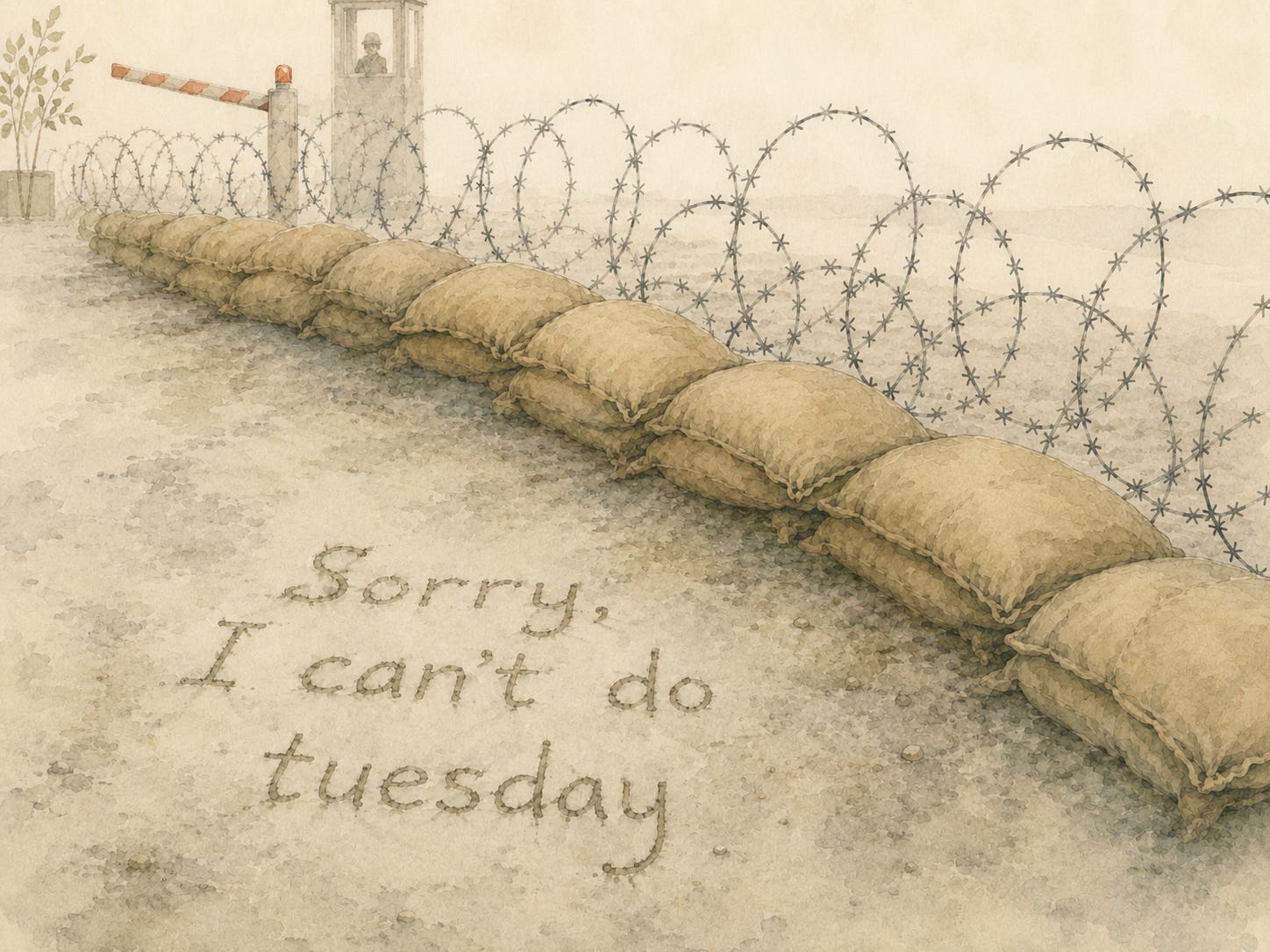
Now at least I understand where I’m coming from: an atmosphere where refusal is provocation and people routinely lash out violently at the smallest slights.
Something to think about if you’re frustrated with your own struggle to set boundaries when it seems easy to others. As with many other afflictions, there could be systemic reasons beyond what you perceive to be your own weakness. Even as you work to slowly develop the skill of boundaries, be understanding with yourself and with where you’ve come from.
What feels like cowardly people-pleasing now may have been an intelligent adaptation to survive an earlier time. The rub is to not let that run your life forever, slowly teaching your nervous system that a boundary isn’t a declaration of war.
This is the second installment in a very sporadic series called “Power Through Shamelessness,” essays about overcoming people pleasing and learning to set boundaries. Read the first installment here.
I did have a cousin and a great aunt who were victims of homicide, and certainly felt deep sadness about it, but for whatever reason those events didn’t make me feel directly fearful for myself or my “core” family. There’s probably a lot to untangle there but that’s not the scope of this post.
This is so insightful! It would/will make a great book. Got the chills!
Much to ponder here, L. Vago.